The Enterprise AI Dilemma: How Fyberloom Brings Intelligence to Your Data Without Forcing Your Data to Leave
Enterprise AI is advancing quickly. Enterprise architecture is struggling to keep up.
Every company is under pressure to adopt artificial intelligence.
Executives want AI embedded into everyday operations. Employees want faster access to information. Business units want assistants that can understand customers, projects, products, procedures, regulations, technical systems, and internal decisions. IT departments are expected to connect generative AI to corporate applications while maintaining security, compliance, governance, and predictable costs.
The promise is compelling: AI should help organizations work faster, make better decisions, preserve expertise, automate repetitive activities, and make decades of accumulated information immediately useful.
The reality is often more complicated.
Most enterprise AI initiatives begin with a seemingly simple idea: connect the company’s applications to an external AI service, retrieve the relevant content, send that content to a model, and generate an answer.
But once this architecture is applied at enterprise scale, companies begin to encounter three fundamental problems.
The first is economic. Most AI systems are based on token consumption, meaning that the more employees use the platform, the more documents are processed, and the more AI agents perform multistep operations, the more the company pays.
The second is security. To generate intelligence, enterprise information is frequently sent outside the applications and infrastructure in which it was originally stored. Documents, emails, messages, customer information, technical records, contracts, and internal discussions may be transmitted to external platforms or external models for processing.
The third is sovereignty. Once enterprise data and derived knowledge move into provider-controlled environments, companies may lose practical control over where that information is processed, how it is retained, which models interact with it, and how easily the organization can move to a different architecture in the future.
These are not marginal concerns. They are structural consequences of the dominant centralized AI model.
Fyberloom was created around a different principle:
An organization should not have to move its knowledge outside its control in order to make that knowledge intelligent.
Fyberloom brings intelligence closer to the places where enterprise information already lives. It operates through a distributed mesh of intelligent knowledge nodes that can be deployed within the company’s infrastructure, close to its data warehouses, repositories, applications, departments, and users.
Instead of building another centralized data silo, Fyberloom creates a knowledge layer across the systems the organization already uses.
The original information remains where it belongs. Fyberloom distills, curates, connects, and retains the knowledge contained within it.
This is the foundation of Fyberloom’s approach to Intelligent Knowledge Mapping .
From enterprise information to enterprise knowledge
Companies possess enormous quantities of information, but information alone does not create intelligence.
A document can contain valuable facts without explaining how those facts relate to a project. An email can record an important commitment without being connected to the customer account, contract, or decision that gives it meaning. A meeting transcript can preserve every word of a conversation while failing to capture which ideas were accepted, which alternatives were rejected, and what happened afterward.
Enterprise knowledge is distributed across many different forms:
- documents and presentations;
- email conversations;
- collaboration platforms;
- customer relationship management systems;
- service and support platforms;
- data warehouses and data lakes;
- file servers and cloud storage;
- business applications;
- meeting transcripts;
- technical repositories;
- and, critically, the experience of the people working inside the organization.
Traditional enterprise systems manage these resources as separate objects.
A file system stores files. A CRM stores customer records. A ticketing platform manages incidents. A collaboration system stores conversations. An enterprise search engine retrieves content matching a query.
These systems are essential, but they do not automatically transform fragmented information into durable organizational knowledge.
That transformation requires two closely connected capabilities: Knowledge Curation and Knowledge Retention .
Together, they form the foundation of Fyberloom’s Intelligent Knowledge Mapping model.
Knowledge Curation: transforming fragmented information into usable intelligence
Knowledge Curation is the continuous process of identifying what matters within an organization’s information environment and connecting it to the contexts in which it becomes useful.
It is not simply indexing documents.
A conventional indexing system may identify words, extract metadata, calculate embeddings, and return resources that appear relevant to a query. This helps employees locate content, but it does not necessarily help them understand the broader organizational meaning of that content.
Knowledge Curation goes further.
It identifies relationships among resources, people, customers, projects, topics, events, decisions, and business processes. It connects information that may originate in completely different applications. It distinguishes current knowledge from outdated information. It preserves the provenance of an insight so that users can understand where it came from.
Consider a project that has been active for several years.
Its knowledge may be scattered across hundreds of documents, thousands of emails, meeting transcripts, technical repositories, support tickets, customer records, and informal decisions. No individual resource contains the complete picture.
Fyberloom can distill the relevant information from those sources and organize it into a living knowledge structure.
Through LiveMaps, Briefing Books, semantic relationships, and contextual knowledge products, Fyberloom helps users understand not only which resources exist, but also how they relate to one another and why they matter.
The result is not another search result page.
It is a continuously evolving representation of what the organization knows.
Knowledge Retention: ensuring that the organization does not forget
Knowledge Curation makes knowledge understandable. Knowledge Retention ensures that it remains available over time.
Organizations lose knowledge every day.
Employees change roles. Experts retire. Contractors leave. Teams are reorganized. Projects end. AI-generated analyses disappear into chat histories. Decisions remain buried in conversations that nobody remembers to search.
The documents may still exist, but the context that made those documents useful gradually disappears.
This is why archiving is not the same as retention.
An archive preserves artifacts. Knowledge Retention preserves meaning.
It retains the relationships among those artifacts, the decisions they supported, the people involved, the circumstances under which they were created, and the evolution of the topic over time.
This difference is strategically important.
When an employee leaves the company, the organization should not lose the understanding accumulated through years of work. When a new employee joins a project, that person should not have to reconstruct the entire history manually. When an AI agent solves a complex problem, the result should not disappear after a single execution.
Fyberloom turns everyday work into persistent institutional memory.
The knowledge created by people and AI systems can continue to support future employees, future workflows, and future agents.
This creates an organizational asset that compounds in value.
The more the company works, the more Fyberloom can curate. The more knowledge is curated, the more context becomes available. The more context is retained, the more effectively people and AI systems can operate.
The architecture behind most enterprise AI systems
To understand why Fyberloom is different, it is useful to examine the architectures currently used by many enterprise AI platforms.
The dominant model is centralized.
In a centralized architecture, many enterprise applications connect to one central processing environment. Data is extracted from the original sources, transferred to the external platform, indexed, transformed, embedded, or copied into a new repository.
The central platform becomes the place where intelligence happens.
Users ask questions. The platform retrieves relevant content. That content is inserted into a prompt and sent to an AI model. The response is then returned to the user.
This architecture is popular because it appears straightforward.
There is one platform, one central index, one central AI service, and one unified interface.
But this simplicity comes at a cost.
The platform becomes a central dependency. It also becomes a central security target, a central cost center, and a central repository containing some of the organization’s most sensitive information.
Every new data source increases the value and risk concentrated in that environment.
A second architectural model is decentralized.
In a decentralized architecture, multiple hubs operate independently. Different departments, subsidiaries, regions, or systems may have their own local centers. This reduces dependence on one universal platform, but each area may still rely on its own central hub.
The result can be a collection of partially independent silos.
Fyberloom follows a third pattern: the distributed architecture.
Fyberloom follows a distributed pattern
Fyberloom is built as a distributed mesh of intelligent nodes.
In a distributed architecture, intelligence is not confined to one central system. Processing capacity, knowledge, and responsibility are spread across multiple interconnected nodes.
Each node can operate independently, but nodes can also collaborate as a coordinated team.
A Fyberloom node can be deployed close to the enterprise systems and information for which it is responsible. It may run inside the company’s infrastructure, near a data warehouse, alongside a document repository, within a departmental environment, on an enterprise server, in a private cloud, or, where appropriate, on an individual device.
The node can access authorized resources, process them, generate semantic representations, identify relationships, create knowledge structures, maintain contextual indexes, and retain organizational memory.
It is not a lightweight gateway that simply forwards enterprise data to a remote AI service.
It is an active knowledge-processing component.
This distinction is fundamental.
In the conventional cloud model, data moves toward the intelligence.
In Fyberloom, intelligence moves closer to the data.
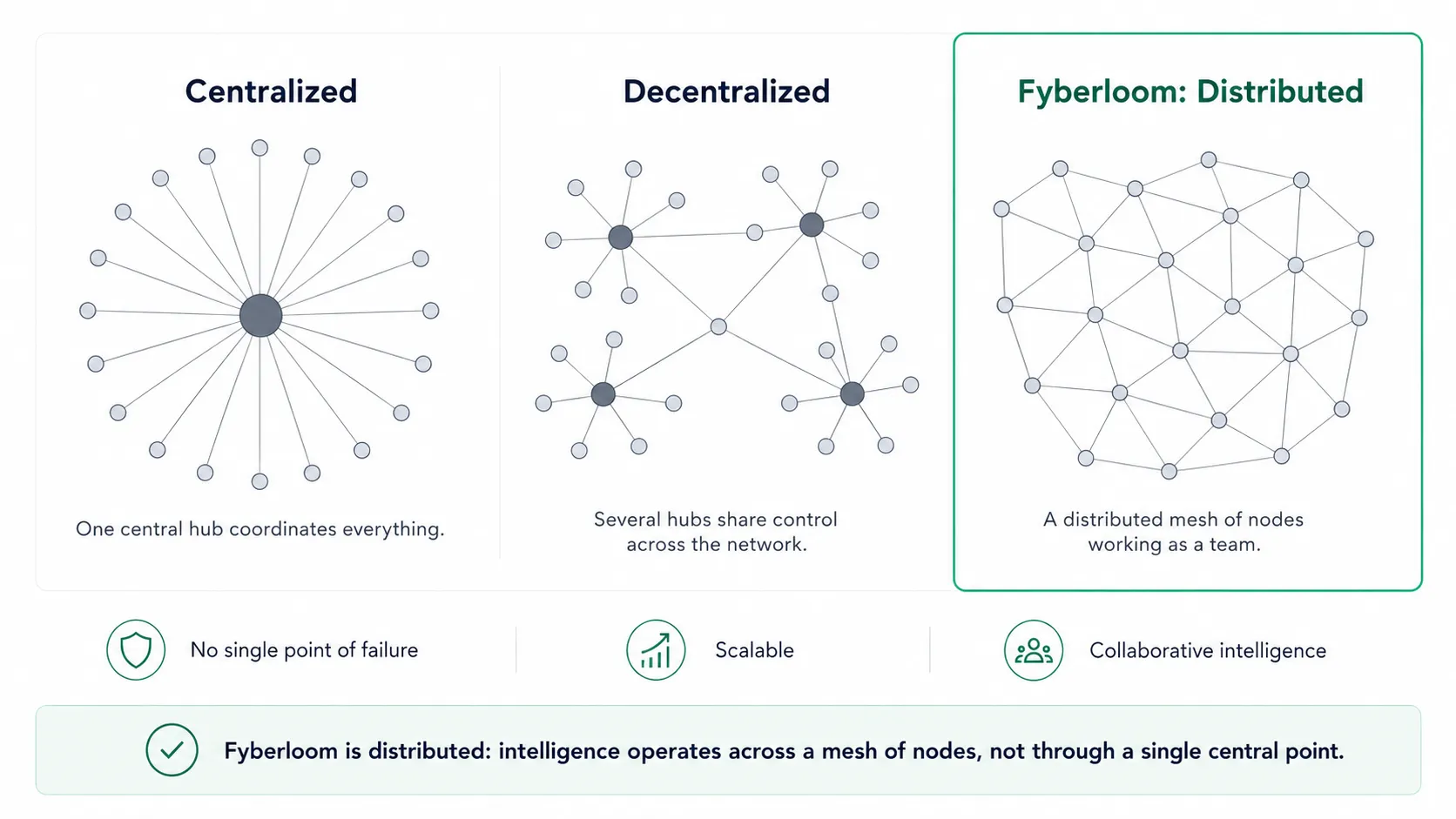
A mesh of nodes that can act as a team
The true power of the Fyberloom architecture does not come simply from having multiple nodes.
It comes from the ability of those nodes to cooperate.
A large organization rarely stores all relevant knowledge in one place.
Customer information may be located in the CRM. Commercial commitments may exist in emails. Contracts may be stored in a document management system. Technical decisions may be contained in engineering repositories. Open problems may be tracked in a service platform. Strategic discussions may exist in meeting transcripts.
A user preparing for an important meeting needs a unified understanding of all these elements.
In a conventional centralized architecture, the organization would typically copy or synchronize all this information into one external platform before the AI system could interpret it.
In Fyberloom, the nodes responsible for each knowledge domain can work together.
The CRM node can contribute customer context. The service node can contribute current incidents. The document node can contribute contractual information. The project node can contribute previous decisions and implementation history.
Each node contributes according to its permissions, its knowledge domain, and the requirements of the task.
Fyberloom can then produce a coherent LiveMap, Briefing Book, answer, or contextual package without requiring every underlying resource to be consolidated into one universal repository.
The knowledge can be distributed while the experience remains unified.
This is the essence of the Fyberloom mesh.
Logical unity without physical centralization
Companies often assume that a unified AI experience requires a unified physical database.
That assumption is not necessarily true.
Fyberloom separates two concepts that are often confused:
- the ability to provide one connected view of organizational knowledge;
- the physical centralization of all enterprise information.
Fyberloom can provide logical unity without requiring physical centralization.
A user can receive one coherent understanding of a project even when the relevant knowledge is maintained by several nodes. An AI agent can obtain the context required to perform a task even when that context originates in different systems and remains governed by different policies.
The enterprise receives a connected knowledge layer without creating another uncontrolled copy of its entire information estate.
This is particularly important for companies that have invested heavily in legacy systems, data platforms, and specialized business applications.
Fyberloom does not require those systems to be replaced.
It makes their knowledge usable together.
The data remains in the applications that own it
One of Fyberloom’s most important architectural principles is that original enterprise data should remain in the applications and repositories designed to manage it.
Customer records belong in the CRM.
Contracts belong in the document management platform.
Financial records belong in the appropriate financial systems.
Operational tickets belong in the service management platform.
Technical artifacts belong in engineering repositories.
These systems are not merely storage locations. They contain access controls, business rules, audit histories, retention policies, and operational workflows.
Moving their contents into a new AI repository creates another environment that must be governed and protected.
It also creates a synchronization problem.
When the original information changes, the external copy must be updated. When permissions change in the original application, the replicated environment must reflect those changes. When data must be deleted, the organization must ensure that all derived and duplicated copies are also removed.
This increases complexity and risk.
Fyberloom avoids the idea that the entire enterprise information estate must be relocated before it can become intelligent.
The original content can remain in the systems of record. Fyberloom nodes operate close to those systems and create the knowledge structures required to connect, interpret, and retain their meaning.
Fyberloom may maintain semantic representations, relationships, indexes, context, and derived knowledge, but the organization does not have to surrender all original resources to an external centralized platform.
The existing applications continue to perform their operational functions.
Fyberloom becomes the intelligent knowledge layer across them.
Why the centralized AI model creates a security problem
Many organizations are trying to deploy AI while asking a difficult question:
How can we use our most valuable information without exposing it to environments we do not fully control?
This concern is justified.
Enterprise AI systems frequently process highly sensitive information:
- customer and employee data;
- commercial negotiations;
- technical documentation;
- intellectual property;
- internal legal communications;
- financial records;
- security information;
- strategic plans;
- product roadmaps;
- and confidential operational conversations.
In a centralized cloud architecture, much of this information may be extracted from enterprise applications and transmitted to an external platform.
Even when strong security controls are in place, the architecture creates an additional attack surface and an additional concentration point.
The external environment may contain not only original content, but also embeddings, summaries, indexes, generated answers, relationship graphs, and other derived representations.
These derived assets can be just as sensitive as the original documents.
A knowledge graph revealing relationships among customers, technologies, contracts, and strategic initiatives may expose information that was never written explicitly in a single source. A summary of an internal investigation can be more revealing than the individual records from which it was created.
Security therefore cannot focus only on protecting raw data.
It must also protect the knowledge derived from that data.
Fyberloom’s distributed, local-first architecture reduces the need to concentrate all enterprise knowledge in one external system.
Nodes can process sensitive resources within the company’s infrastructure. Knowledge can remain inside designated environments. External models can be used selectively rather than becoming the mandatory execution location for every operation.
This changes the security posture of the platform at a structural level.
Reducing the security blast radius
A centralized knowledge repository can become one of the most valuable targets inside the enterprise architecture.
It may contain information from many departments, countries, subsidiaries, customers, and projects.
If credentials are compromised, permissions are misconfigured, or a vulnerability is exploited, the impact may extend across the entire organization.
A distributed model can reduce this concentration.
Different knowledge domains can remain in different nodes. A legal node can remain separated from a commercial node. A regional node can retain information governed by local rules. A project node can be restricted to the people and agents assigned to that project.
This creates a smaller potential blast radius.
A security event affecting one environment does not automatically imply access to every knowledge domain across the enterprise.
The architecture can also support least-privilege access more naturally.
A user or agent receives only the knowledge required for the task and authorized by the relevant nodes. The mesh does not need to expose every underlying source merely because a cross-domain response is required.
The nodes can contribute selected knowledge while preserving the boundaries of the original systems.
Data sovereignty is more than data residency
Many AI providers describe sovereignty primarily in terms of data residency.
They may allow customers to choose the geographical region in which their data is stored.
This is important, but it is only one part of sovereignty.
True data sovereignty requires control over the entire lifecycle of information and derived knowledge.
A sovereign organization should be able to determine:
- where its original information remains;
- where that information is processed;
- where semantic indexes and embeddings are stored;
- which models are allowed to interact with it;
- which legal entity operates the infrastructure;
- which users, applications, and agents may access it;
- whether knowledge can cross a departmental or national boundary;
- and how the information and its derived representations can be deleted or transferred.
A dataset can be geographically stored in the correct region while the organization still remains dependent on a provider-controlled architecture.
The provider may still determine the processing model, the permitted models, the operational interfaces, and the commercial structure.
Fyberloom’s distributed architecture offers a stronger foundation for sovereignty because the organization can decide where individual nodes operate and which knowledge domains they control.
A company can deploy nodes inside its own infrastructure. It can maintain regional nodes for different countries. It can separate subsidiaries or departments. It can process highly sensitive information locally while using managed services for less restricted workloads.
The organization does not have to adopt one universal rule for all its knowledge.
This makes sovereignty an architectural property rather than merely a contractual promise.
From data sovereignty to knowledge sovereignty
As enterprise AI becomes more sophisticated, the concept of sovereignty must expand.
The most valuable asset may no longer be the original data alone.
It may be the knowledge generated from that data.
AI systems can infer relationships, identify patterns, summarize strategic discussions, classify risks, and reconstruct the history of projects or customer relationships.
These outputs represent organizational intelligence.
A company’s semantic understanding of its customers, people, operations, and intellectual property may become one of its most valuable assets.
If that understanding exists only inside an external provider’s platform, the organization may remain dependent on that provider even if the original documents are stored elsewhere.
Fyberloom is designed around the principle of knowledge sovereignty.
The enterprise should control not only its source data, but also the knowledge distilled from it.
That includes semantic structures, contextual maps, retained decisions, organizational memory, project histories, and AI-generated intelligence.
Fyberloom nodes can retain these assets inside the environments selected by the company.
The company remains the owner of its information and of the intelligence derived from it.
Local-first does not mean local-only
Fyberloom is local-first, but it is not limited to isolated local deployments.
Local-first means that the enterprise environment is treated as a first-class location for intelligence.
A local Fyberloom node can perform substantive knowledge operations. It can connect to sources, process information, create semantic representations, maintain indexes, curate knowledge, and retain context.
It is not merely a front end for a remote cloud platform.
At the same time, Fyberloom can use enterprise, private-cloud, and managed infrastructure when those environments are appropriate.
This creates a flexible architecture.
Sensitive data can be processed locally. Shared enterprise knowledge can be maintained in authorized organizational nodes. Computationally demanding activities can be assigned to more powerful nodes. Approved external models can be used selectively.
The company decides where each type of intelligence should run.
This is very different from a cloud-first system in which every meaningful operation ultimately depends on the remote provider.
Local-first gives the enterprise options.
It allows infrastructure decisions to follow business, security, regulatory, and performance requirements.
Three deployment models, one distributed architecture
Fyberloom can support different deployment requirements without changing its core architectural philosophy.
On-premises mesh
In an on-premises deployment, Fyberloom nodes run inside the customer’s own infrastructure.
This model provides the highest degree of direct operational control. Information processing, semantic indexing, knowledge curation, and knowledge retention can remain within the company’s environment.
An on-premises deployment can be particularly important for regulated industries, public institutions, companies managing sensitive intellectual property, and organizations with strict security or contractual requirements.
The nodes can still collaborate as a distributed mesh. On-premises does not mean that Fyberloom becomes one central server.
Different departments, locations, or knowledge domains can operate their own nodes while remaining part of the broader enterprise architecture.
Managed SaaS
Some organizations prefer not to manage the infrastructure directly.
Fyberloom can also be delivered as a managed environment. This reduces operational complexity while preserving the core principles of node-based knowledge processing and controlled knowledge domains.
The SaaS option allows companies to adopt Fyberloom more quickly while maintaining a different architecture from conventional centralized AI platforms.
Hybrid deployment
For many enterprises, the hybrid model offers the most practical balance.
Sensitive resources can remain on-premises. Departmental nodes can operate close to local systems. Shared enterprise services can be provided through central organizational nodes. Approved cloud resources can support selected workloads.
The company can define which knowledge stays local, which knowledge is shared, and which workloads may use external computation.
The architecture adapts to the enterprise rather than forcing the enterprise to adapt to one infrastructure model.
The economic problem with token-based AI
Security and sovereignty are not the only problems facing enterprise AI adoption.
Companies are also discovering that the dominant pricing model can become unpredictable and difficult to scale.
Most generative AI services are priced according to token consumption.
Every time a user sends information to a model, input tokens are consumed. Every time the model generates an answer, output tokens are consumed.
In more complex systems, the company may also pay for:
- embeddings;
- reranking;
- vector searches;
- model calls;
- agent steps;
- tool calls;
- document extraction;
- summarization;
- and repeated processing of the same information.
This means that the cost of the system grows with activity.
At first, the numbers may appear manageable. A small pilot with a limited number of users generates limited consumption.
But the economics change when AI becomes part of everyday enterprise work.
Thousands of employees may ask questions. Documents may be reprocessed repeatedly. AI agents may perform dozens of model calls to complete one visible task. Long context windows may include large amounts of enterprise content.
The company may not even know how many internal operations are occurring behind each user interaction.
A single answer can require retrieval, planning, classification, synthesis, validation, and revision.
Every step may consume tokens.
Successful adoption should not become a cost problem
Token-based pricing creates a paradox.
The more successful the AI deployment becomes, the more expensive it may become.
This can lead companies to restrict usage precisely when they should be encouraging it.
Employees may receive quotas. Departments may be assigned consumption budgets. Certain documents may be excluded because they are expensive to process. Context windows may be reduced. More capable models may be reserved for a small group of users.
The architecture begins to optimize for token reduction rather than knowledge quality.
This creates friction.
An employee should not have to consider whether a question is important enough to justify its token cost. An AI agent should not stop reasoning because the organization is concerned about the number of intermediate calls. A company should not be penalized economically because its employees are actively using organizational knowledge.
Enterprise knowledge infrastructure should encourage adoption.
It should become more valuable as more people use it.
Fyberloom replaces token uncertainty with a flat platform model
Fyberloom is designed around a flat pricing approach rather than ordinary token-based consumption billing.
The customer pays for access to the platform and its knowledge capabilities rather than being charged according to the number of tokens consumed during everyday use.
This creates greater predictability.
Organizations can plan their expenditure. Departments can introduce new use cases without calculating the cost of every question. Employees can use the system without worrying that each interaction contributes to an unpredictable bill.
AI agents can operate as part of enterprise workflows without turning every internal reasoning step into a separate customer charge.
This commercial model reflects the role Fyberloom is intended to play.
Fyberloom is not simply a wrapper around an external language model.
It is an enterprise knowledge infrastructure.
It includes distributed nodes, connectors, semantic processing, knowledge curation, knowledge retention, contextual mapping, access control, and the mechanisms through which people and agents interact with organizational memory.
Language models are important components, but they are not the product.
The product is the knowledge layer.
Processing knowledge once and reusing it many times
The economic advantage of Fyberloom is connected to its architectural model.
Many AI systems repeatedly send the same information to external models.
A document may be summarized for one employee, then summarized again for another. The same project history may be reconstructed every time someone asks a related question. Different agents may retrieve and process identical content without reusing previous knowledge.
The company repeatedly pays to rediscover what it already knows.
Fyberloom is built to curate and retain knowledge.
Once information has been analyzed and connected to a knowledge structure, that work can continue to provide value. The resulting context can support multiple users, applications, workflows, and agents.
A project LiveMap can evolve over time. A Briefing Book can incorporate new resources. A resolved technical issue can become part of the company’s retained expertise. An AI-generated analysis can contribute to future decisions.
The system does not begin from zero every time.
This creates compounding efficiency.
The enterprise gradually builds a knowledge asset rather than repeatedly purchasing isolated AI responses.
From ephemeral answers to persistent intelligence
A conventional generative AI system is primarily designed to answer a question.
The answer may be useful, but it is frequently ephemeral.
It appears in a conversation, supports a decision, and then disappears into the history of the application.
The reasoning behind it may not be retained. The relationships discovered during the analysis may not become part of the organizational knowledge base. Other employees may not know that the work was already completed.
Fyberloom changes the lifecycle of AI-generated intelligence.
An answer can become part of a persistent knowledge structure. A decision can remain connected to the evidence that supported it. A new insight can enrich an existing LiveMap. An agent’s successful resolution of a problem can become available to future agents.
The objective is not merely to generate intelligence.
It is to retain intelligence.
This is particularly important as companies move from individual AI assistants to autonomous and semi-autonomous agents.
AI agents need memory, context, and boundaries
AI agents are expected to perform increasingly complex enterprise tasks.
They may analyze customer information, prepare reports, resolve service incidents, monitor operations, produce technical documentation, or coordinate workflows across multiple applications.
To perform these activities effectively, agents need context.
They need to understand previous decisions, project history, customer relationships, organizational policies, and the current state of relevant work.
Without a persistent knowledge layer, each agent must reconstruct this context repeatedly.
This is inefficient and potentially dangerous.
Agents may reach inconsistent conclusions. They may repeat earlier mistakes. They may fail to understand why a previous decision was made. They may operate using incomplete or outdated information.
Fyberloom provides a knowledge foundation for agents.
Agents can access curated and retained organizational knowledge rather than relying only on raw search results. They can receive context assembled from multiple authorized nodes. Their own outputs can be returned to the knowledge layer and made available for future work.
At the same time, the distributed architecture preserves boundaries.
Not every agent should have access to every company resource.
An agent working for a customer support function may need product documentation and account history, but it may not need access to confidential financial information. A legal agent may require contracts without access to unrelated employee records.
Fyberloom nodes can expose knowledge according to role, context, task, and authorization.
This allows organizations to scale agentic AI without creating one universal, overprivileged data pool.
Better use of enterprise infrastructure
A distributed local-first architecture can also make more efficient use of the infrastructure the company already owns.
Many enterprises have substantial computing, storage, and networking resources inside their own environments.
A purely centralized cloud model ignores much of this capacity and transfers workloads to external services.
Fyberloom nodes can use local or enterprise resources where appropriate.
Document processing can occur near the source. Semantic indexing can remain inside the enterprise. Local models can handle sensitive tasks. More powerful internal nodes can support shared workloads.
Cloud resources can still be used when they provide clear value, but they are no longer the only possible execution environment.
This allows companies to balance performance, confidentiality, operational cost, and computational requirements.
The question is no longer, “Which external model must receive this data?”
The question becomes, “Which authorized node is the most appropriate place to perform this task?”
Performance through proximity
Moving large volumes of data across networks is not always efficient.
Enterprise repositories may contain millions of documents. Operational databases may change continuously. Data warehouses and data lakes may store enormous volumes of information.
Sending all this content to a remote environment can create latency, bandwidth consumption, synchronization delays, and unnecessary processing.
A Fyberloom node located close to the source can process information without repeatedly transferring the original content across external networks.
This proximity can improve response times and reduce infrastructure overhead.
Local indexes and retained knowledge can support rapid contextual access. Frequently used information does not need to be reconstructed for every request. Nodes can update knowledge incrementally as new information appears.
The architecture processes knowledge where that processing is most effective.
Resilience without total dependence on one external service
A fully centralized AI platform creates a broad operational dependency.
If the remote service is unavailable, network connectivity is interrupted, or the provider changes its operational policies, the entire knowledge experience may be affected.
A distributed architecture can reduce this dependence.
Local and enterprise nodes can continue to provide access to the knowledge they retain, depending on the functions and configuration selected by the customer.
The system does not require every operation to make a round trip to one external service.
This does not eliminate the value of shared cloud services, but it prevents them from becoming the only place where intelligence exists.
Resilience is created through distribution.
Fyberloom as middleware for enterprise intelligence
Fyberloom is not intended to replace every application through which employees and customers interact.
It can operate as the knowledge middleware beneath many different interfaces and workflows.
Users may access Fyberloom knowledge through LiveMaps, Briefing Books, search, conversational interfaces, or dedicated applications.
But the same curated knowledge can also be made available to:
- enterprise portals;
- service management platforms;
- workflow automation systems;
- collaboration tools;
- analytics applications;
- customer service interfaces;
- AI assistants;
- and autonomous agents.
This is particularly valuable for system integrators and enterprise solution providers.
They can use Fyberloom as the persistent knowledge layer beneath solutions developed for different customers and industries.
The interface can change. The workflow can change. The agent can change.
The knowledge foundation remains consistent.
A new relationship between AI and enterprise applications
The dominant enterprise AI architecture attempts to create intelligence by extracting information from business systems and moving it into a new AI environment.
Fyberloom creates a different relationship.
The applications remain responsible for the operational data they manage. Fyberloom nodes operate close to those applications and distill their contents into connected knowledge.
The CRM does not need to become a document system. The document repository does not need to become an AI platform. The data warehouse does not need to become an organizational memory.
Fyberloom connects these environments at the level of knowledge.
It creates a semantic and contextual layer across them while preserving their original roles.
This approach reduces disruption and allows organizations to introduce AI incrementally.
A company can begin with a specific department, project, or knowledge domain. Additional nodes and connectors can be introduced over time.
The knowledge mesh grows with the organization’s adoption.
Why the distributed pattern wins
The distributed pattern is not simply a technical preference.
It provides a direct response to the principal barriers preventing companies from adopting AI confidently.
It addresses security because sensitive information can be processed closer to its source rather than automatically transferred to an external centralized platform.
It supports sovereignty because the company determines where its nodes, data, models, and derived knowledge operate.
It improves cost predictability because Fyberloom is designed around a flat platform model rather than ordinary token consumption billing.
It improves efficiency because curated and retained knowledge can be reused instead of reconstructed repeatedly.
It reduces dependency because intelligence does not have to exist exclusively inside one provider-controlled environment.
It supports organizational complexity because departments, subsidiaries, regions, and security domains can maintain their own boundaries while participating in one broader knowledge mesh.
It creates a better foundation for AI agents because agents can access persistent context without receiving unrestricted access to the entire information estate.
Most importantly, it allows companies to become more intelligent without first surrendering control over the information that makes them unique.
The enterprise should own its intelligence
The long-term value of enterprise AI will not come only from access to large language models.
Models will continue to evolve. New providers will emerge. Costs and capabilities will change.
The durable advantage will come from the organization’s own knowledge.
Its history. Its decisions. Its customer understanding. Its technical expertise. Its processes. Its failures. Its lessons. Its relationships. Its accumulated context.
This knowledge belongs to the enterprise.
It should not be trapped inside disconnected applications. It should not disappear when employees leave. It should not have to be reconstructed every time an AI system is asked a question.
It should also not become dependent on a single external model provider.
Fyberloom gives companies a way to curate, retain, connect, and activate their knowledge while maintaining control over where that knowledge lives and how it is processed.
The architecture is distributed.
The design is local-first.
The data can remain in the systems that own it.
The nodes can operate close to the company’s data warehouses, applications, and repositories.
The nodes can act independently, but they can also collaborate as a team.
The pricing is designed to be predictable rather than driven by ordinary token consumption.
The result is a knowledge infrastructure built for enterprise AI, not simply an AI interface placed on top of enterprise data.
Intelligence should move. Your data should not have to.
Most enterprise AI platforms begin by asking the company to move information toward a centralized intelligence system.
Fyberloom begins from the opposite direction.
It distributes intelligence across the environments where enterprise information already exists.
It allows nodes to curate knowledge locally, retain organizational context, collaborate securely, and provide a unified experience across the company.
It gives organizations the ability to use AI without automatically transferring their most valuable information to external models.
It protects data sovereignty and extends that protection to the knowledge derived from the data.
It replaces unpredictable token-based usage with a flat platform model designed for broad adoption.
And it transforms fragmented information into a persistent organizational memory that can support employees, applications, workflows, and agents.
The future of enterprise AI should not be based on moving everything into one external intelligence silo.
It should be based on bringing intelligence to the enterprise, operating close to its data, and allowing knowledge to move securely across a distributed mesh.
That is the architecture behind Fyberloom.
Your data remains where it belongs. Intelligence operates where it is needed. Knowledge becomes available across the organization.
Start your 7-day free trial Get early access to fyberloom, explore your own LiveMaps, and unlock the full version after the trial. The next onboarding batch opens soon, so reserve your spot now.